
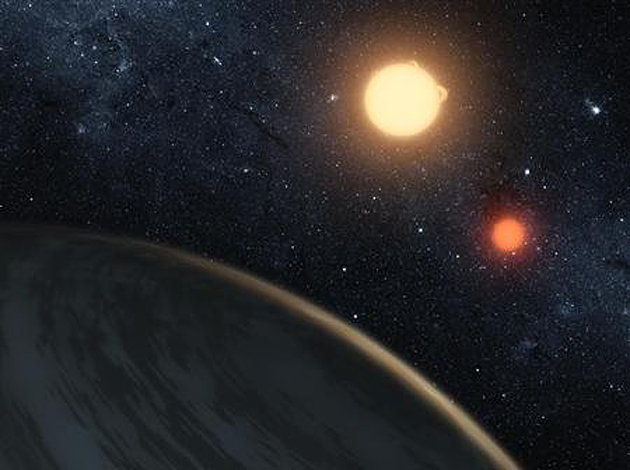
Tatooine is a real life. A show that popularized the “Star Wars” saga – a planet with two suns – has been confirmed in the space for the first time, astronomers revealed.
Scientists using the Hubble NASA‘s Kepler space captured the details of a giant planet orbiting the binary pair of stars that make up the Kepler-16 system, which is about 200 light years away.
“This discovery is surprising,” said study co-author, Alan Boss of the Carnegie Institution in Washington. “Once again, it used to be science fiction has become reality.”
When Tatooine was depicted in the film, many scientists doubted that such planets could actually exist. Now there’s proof.
“There may be a real Tatooine out there,” said John Knoll, visual effects supervisor signature Light and Magic special effects industry, who was behind the “Star Wars” films. “Kepler 16b is unmistakable evidence that dramatic reality planets form around binary”.
The new discovery is expanding the boundaries of what scientists and filmmakers, it is conceivable.
“Time and again we see that science is stranger and cooler than fiction,” Knoll said at a news conference at NASA today. “The very existence of these findings give us reason to dream bigger, to challenge preconceived ideas.”
The planet, called Kepler-16 (AB)-b, passes in front of two stars in the sight of the satellite, regular dimming its light. Each star also eclipses its companion as they orbit each other. Taken together, these moves allow scientists to accurately calculate the masses, radii and the trajectories of three bodies.
The newly discovered planet stands at a distance from their stars almost three-quarters of the distance between Earth and sun. It is like Saturn in size, although nearly 50 percent more dense, suggesting that it is richer in heavy elements. [10 foreign real worlds that might be in ‘Star Wars’]
“Kepler-16 (AB)-b is not living as we know,” said lead study author Laurance Doyle, an astrophysicist at the Search for Extraterrestrial Intelligence (SETI) in Mountain View, California
This strange world travels in a nearly circular orbit around 229 days of its two parent stars, Kepler and Kepler 16A-16B, which are about 69 and 20 percent of the sun’s mass, respectively. The stars remain close to each other – only one fifth of the distance between Earth and sun, on average, closer than Mercury receives the sun – to complete one orbit around each other every 41 days, the researchers added.
Worlds orbiting two stars, called circumbinary planets, had hinted earlier. Stars in pairs, in orbit around a point in space called the centroid, and researchers sometimes saw these orbits were slightly, suggesting the presence of a planet by pulling the two stars. However, Kepler-16 (AB)-b is the first planet that scientists have detected directly passing in front of, or transiting, its star, temporarily regulating light.
Since the movements of this world and its two stars are practically confined to one plane, the researchers suggest that all formed from the same disk of dust and gas. The planets that were captured from other star systems would be expected to orbit at a variety of angles.
Incoming Search Terms:
- planet earth
- planet 51
- planet clothing